
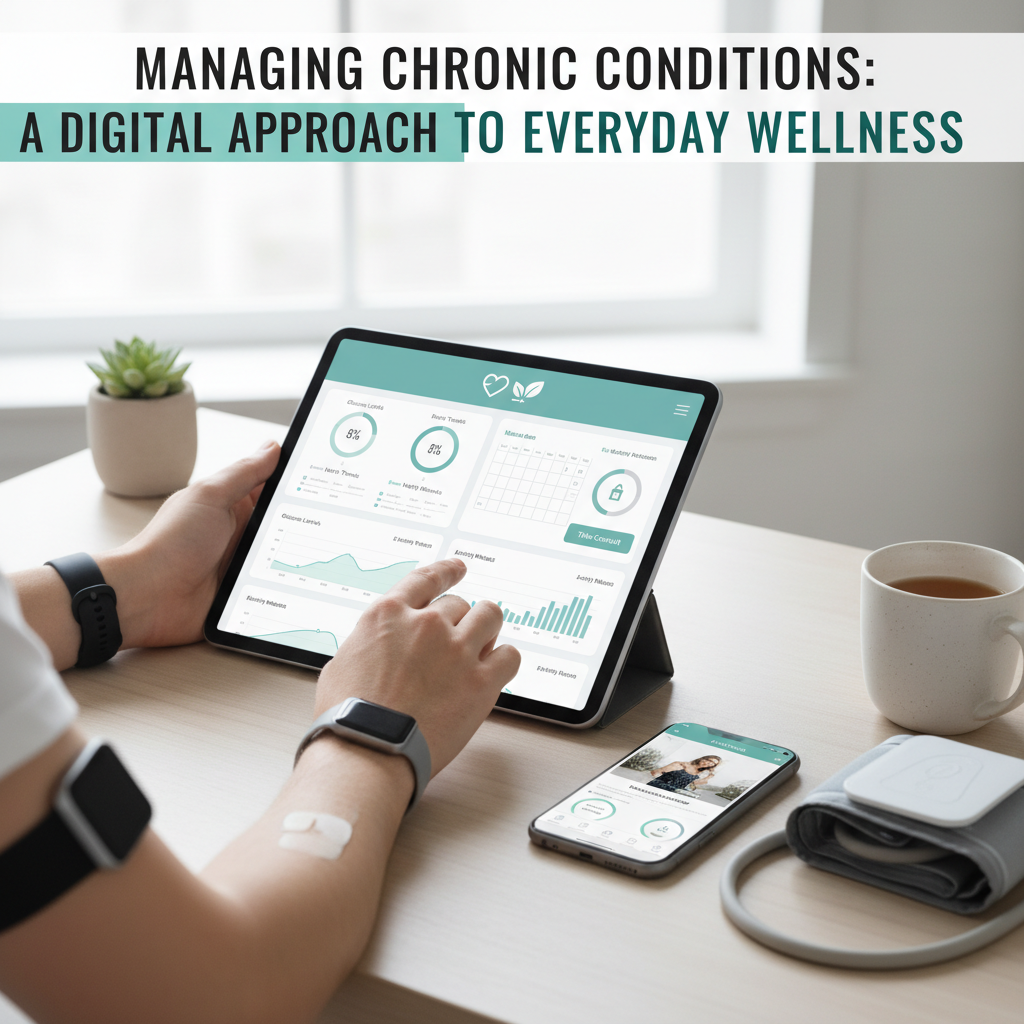
If you’re managing a long-term condition or supporting someone who is, the daily grind of meds, symptoms, and appointments can feel never-ending, and you’re probably worried about missed readings, confusing apps, or care that doesn’t stick. Our approach simplifies chronic condition management with digital health tools that actually fit into real life — we evaluate wellness apps, remote monitoring, telehealth, and hybrid models so you can pick what works and avoid costly dead ends.
Why digital options matter for chronic condition management
Chronic illness isn’t a one-off problem. It’s 365 days of decisions, and digital tools let care move off the clinic floor and into the day-to-day (where it counts). Digital health can mean fewer ER trips, faster adjustments to medication, and measurable behavior change if the technology is chosen and used right. From what I’ve seen, the difference between an app that helps and one that collects dust is less about features and more about fit – who uses it, how it’s integrated with clinicians, and whether it respects privacy.
Comparing the main digital approaches
Let’s compare the common options side-by-side so you can match the tool to the problem. Think of this like choosing between a Ferrari and a bicycle – both get you places, but the use case matters.
Wellness apps (mobile apps for tracking, education, behavior)
What they do: Track symptoms, meds, sleep, activity; deliver education and nudges; sometimes include coaching or peer forums.
Best for: People who want self-management, low-cost support, behavior change nudges, and daily reminders.
Pros: Low entry cost, easy onboarding, lots of choices (there are thousands of wellness apps in 2026 marketplaces), fast iteration.
Cons: Engagement drops fast – I’ve seen active use fall to 35% by month 3 when there’s no clinician touch or incentives. Data often stays siloed on the phone, and clinical validation varies widely.
Clinical fit: Good for mild-to-moderate conditions, lifestyle support (diabetes prevention, hypertension lifestyle changes), and early-stage self-management.
Remote monitoring (connected devices and real-time data)
What it does: Sends objective readings – blood pressure, glucose, weight, oxygen, heart rate variability – to clinicians or platforms for review.
Best for: Conditions where a vital sign or biomarker predicts deterioration, like congestive heart failure, diabetes, COPD.
Pros: Objective data improves clinical decision-making, can trigger alerts that prevent hospitalizations, and many devices are reimbursable under expanded 2026 remote monitoring codes.
Cons: Hardware costs, connectivity headaches, and clinician alert fatigue if thresholds aren’t tuned. Patients sometimes find devices intrusive or confusing.
Clinical fit: High for moderate-to-high risk patients who need frequent measurement and timely intervention.
Telehealth (video visits and virtual check-ins)
What it does: Replaces or supplements in-person visits with synchronous virtual appointments, and often asynchronous messaging.
Best for: Medication adjustments, routine follow-ups, mental health comanagement, and triage.
Pros: Fast access, reduces travel burden, and integrates well into longitudinal care when combined with remote monitoring.
Cons: Limited physical exam capability, some reimbursement variability depending on payer and state, and equity issues if patients lack reliable internet.
Clinical fit: Excellent for maintenance visits and early intervention after alerts from remote monitoring.
Chronic care management platforms (integrated software with workflows)
What they do: Combine data ingestion, care team workflows, analytics, and patient engagement into one interface designed for clinics or payers.
Best for: Health systems, clinics, and large practices managing cohorts of patients and aiming to scale personalized care.
Pros: Centralized dashboards, care gaps management, automated outreach, and better EHR integration for documentation and billing.
Cons: Implementation projects can take 3 to 6 months, costs are higher, and success depends on clinician adoption and workflow redesign.
Clinical fit: Ideal for organizations wanting population-level improvements in A1c, BP control, or readmission reduction.
Hybrid programs (digital plus human coaching)
What they do: Blend apps and monitoring with human coaches or nurses for accountability and escalation.
Best for: Patients who need ongoing motivation, social support, and a safety net for complex decisions.
Pros: Higher retention, better outcomes (I’ve seen sustained engagement for 12 months in programs that include weekly coach check-ins), and better prevention of escalation.
Cons: Higher per-patient cost than standalone apps, and scaling requires hiring and training coaches.
Clinical fit: Strong for high-risk patients, those with behavioral health comorbidity, and people who need structured support.
How to choose the right digital health mix for chronic condition management
Not every patient needs every tool. Match the technology to clinical risk, digital literacy, and goals. Here’s a simple decision path that works in practice.
Step 1 – Define the clinical objective
Is the goal to reduce hospital readmissions, improve medication adherence, lower A1c, or boost daily activity? Pick one measurable target. Clear goals make ROI calculations possible.
Step 2 – Assess the patient population
Look at age, tech access, literacy, language, and comorbidities. For a clinic with 400 patients and 120 identified as high risk, remote monitoring plus weekly coaching may be worth the investment. For younger, tech-savvy cohorts, a lightweight wellness app might be enough.
Step 3 – Check interoperability and workflows
Choose solutions that connect to your EHR or at least export standardized reports. If data doesn’t reach the clinician in an actionable way, it’s noise. Train staff on alerts and thresholds so clinical burden doesn’t spike.
Step 4 – Pilot with metrics and iterate
Run a 90-day pilot with 30 patients, track engagement (logins, measurements), clinical markers (BP, A1c), and utilization (ER visits). Use those numbers to scale or pivot.
Practical tips to boost patient engagement
Engagement is the secret sauce. Without it, even the most sophisticated remote monitoring program fails. Try these evidence-informed tactics.
- Start with a quick onboarding call (10 minutes) to set expectations and personalize alerts.
- Use human follow-up for the first 21 days (most drop-off happens early).
- Keep tasks bite-sized – ask for one daily check-in, not 12 fields of data.
- Make data meaningful – show trends and one sentence insights (“Your average BP this week is 6 points lower”).
- Offer incentives that matter locally (pharmacy gift cards, clinic rewards, or reduced copays when feasible).
Privacy, security, and reimbursement – the real constraints
Security isn’t optional. Make sure vendors are HIPAA-compliant, use end-to-end encryption, and offer clear consent flows. Reimbursement has evolved in 2026; many insurers and CMS codes now support remote physiologic monitoring and chronic care management, but billing requires documented workflows and time-based entries. If your clinic wants to get paid, build billing rules into the pilot from day one.
Case examples – short, real-world snapshots
Patient A – 58-year-old with heart failure: We put a weight scale and remote BP monitor on the couch, and a nurse reviewed thresholds daily. Result – 1 hospitalization avoided in 6 months thanks to a timely med adjustment.
Patient B – 42-year-old with type 2 diabetes: A hybrid program with an app plus weekly coaching led to A1c drop from 9.2 to 7.4 over 5 months, and the patient reported better sleep and confidence managing insulin.
When to bring in outside help
If this feels overwhelming, our team can handle the vendor evaluation, pilot design, and workflow integration so you don’t reinvent the wheel. We focus on measurable outcomes and fast iteration, and we’ll help you identify the smallest viable pilot that proves value.
Frequently Asked Questions
How effective are wellness apps for long-term chronic condition management?
Short answer – they can help, but only if engagement is sustained and there’s clinical oversight. Apps are great for education and daily reminders, and when paired with human support or automated alerts tied to clinical workflows, they move the needle. Alone, pure self-guided apps often see steep drop-off within 90 days.
Will remote monitoring actually reduce hospital visits?
Yes, in many cases. Remote monitoring that triggers timely clinical outreach has been shown to reduce readmissions for conditions like heart failure and COPD. The key is tuning alert thresholds, reducing false positives, and ensuring clinicians can act on data quickly.
What are the cost considerations for clinics starting a digital program?
Costs include devices, platform subscriptions, implementation, and staff time for monitoring and outreach. Budget for a pilot: plan on 90 days, 30 patients, and set aside funds for device procurement and 1 part-time clinician or nurse. If reimbursement applies, many programs pay for themselves within 6 to 12 months when readmissions and urgent visits fall.
How do you ensure equity when deploying digital health tools?
Start by assessing patients’ access to smartphones and broadband. Offer alternative entry points like phone calls or low-tech devices, provide language support, and include digital literacy training. Equity requires intentional design, not an afterthought.
How quickly can a clinic get a program up and running?
Fast pilots can launch in 4 to 8 weeks with an off-the-shelf platform and a focused workflow. More complex EHR integrations and large-scale rollouts take 3 to 6 months. The trick is to start small, measure, and scale based on real outcomes.

CEO/Jack of all trades master of none! The Daily SEM
Father of 4 awesome kids! Trying to survive!
Don’t get bogged down by the bells and whistles out there.
His #1 online business pick for 2023 and beyond to grow your own 6/7-figure business getting results now for clients vs later. Learn more here
